Composting Connections from Haida Gwaii

October 22, 2025


By Kayla

I recently had the valuable opportunity to see a medium scale community composting facility in operation in Old Masset on Haida Gwaii during a personal holiday. The community there has about 80 households filling 5-gallon buckets with food scraps from their kitchen, and then employees of the project pick up the bucket contents and bring them back to their EarthFlow composter – “an automated compost mixing and aeration system” inside a shipping container. Food waste is added to the shipping container, an auger breaks up and mixes the materials, automated irrigation can be toggled on and off depending on the moisture level of the feedstock, gases and emissions are captured in a biofilter before being released outside. While the community in Old Masset is still honing their process of storage, curing and use for the finished compost, they are excited that they are diverting a lot of waste from their landfill! Through this program they are building community, creating climate resilience as they process their own waste, creating a valuable soil amendment to nourish their sandy soils, and they are creating valuable employment opportunities for community members. I loved seeing this project in action and seeing Dave’s market garden where some of the finished compost is completing its curation phase.

Thank you so much to Calvin and Trudy and Filene from the Indigenous Zero Waste Technical Advisory Group for connecting me to Dave and for supporting such a great community scale composting operation in Old Masset. I’m very happy to hear that IZWTAG is also supporting many other composting systems of this scale across the province in different communities. Thank you to Dave for showing me around his market garden and garden scale composting operation and showing me the EarthFlow composter in action in Old Masset.

I feel so inspired to be connected to a wider community of people who care about stewarding the soil, reducing methane emissions from landfill, and building community resilience. Us compost keeners are everywhere 😉

Posted in Blog, Composting, Food Security, Reflections, Sustainability, Waste Diversion

Looking for Strategic Clarity

September 12, 2025


by Claire

When I first started at the Compost Ed Centre (about 2 ½ years ago!), I remember being awestruck – and frankly, a bit overwhelmed – by all the different things the organization was doing. I was a new Executive Director after several years of turnover in the position (although amazingly, very little turnover in other staff positions), and I felt like we were in transition as an organization. In the absence of stable and consistent strategic leadership, I saw what I called “mission spill,” (or what someone else generously and thematically referred to as “organic growth amidst resource scarcity”). We were doing a little bit of everything related to composting, gardening, and conservation; and while those three topics are interrelated, I was finding it difficult to express with confidence what it was we were trying to achieve and whether we were being effective.

We did an initial strategic planning session in the first year I was at the organization, and the process was positive. It consisted of a staff retreat, surveying our community and key stakeholders, a facilitated weekend discussion with staff and board, and follow-up staff discussions. We came to a shared understanding that we were doing great work that our community appreciated. And our community’s hopes for the future? That we keep doing what we do – and possibly expand!

However, due a lack of time and expertise, our initial strategic planning process created a sense of overwhelm because of how much time we collectively spent in a “generative” mode without creating much-needed strategic clarity tools like an impact statement, theory of change, or action plan. We started a lot of conversations without finishing them, produced a wish list of blue-sky ideas, and left feeling like we had added a lot to our plate without taking anything off it.

It felt very clear to me after a year in the Executive Director position that we didn’t have any strategic guardrails in place. We were doing a little bit of everything – and our community loved it – but we couldn’t assess how impactful we were being. At a more foundational level, we hadn’t articulated our hypotheses around our intended impact and theory of change – and that made it difficult to figure out our strategic priorities and action plan.

  • Intended impact statement: A clear and rigorous statement of the impact that it will hold itself accountable for achieving
  • Theory of change: A logical flow describing how their work leads to achieving that intended impact.
  • Strategic priorities and action plan: an outline of the work required to implement the theory of change.

At this point in the process, I was beyond grateful to connect with Stephanie and Véro of Garrow & Evoy. With the support of MakeWay funding through Innoweave, a core group of staff and board members embarked on an almost 12-month process of developing our intended impact statement, theory of change, and action plan. We discussed, consulted with stakeholders, analyzed our programs, and discussed again. We were well-supported by our coaches Stephanie and Véro, and they led us – with insightful and challenging questions, endless examples from other organizations, and a lot of enthusiastic support – to our “final” products.

Check out our Theory of Change (beautifully assembled by Zoe-Blue) and let us know what you think.

Posted in Announcement, Blog, Reflections, Stategic Planning

Is it too late?

August 14, 2025


Recently, the famous Canadian environmentalist, David Suzuki was interviewed by iPolitics and, contrary to his typically direct but hopeful rhetoric, he shared his current wisdom about climate change: “it’s too late.”

It was shocking to read even though I’ve acknowledged to myself and my community that I believe we are in a slow downward state of collapse of the environment, social systems, and the economy. While I am someone who has stayed hopeful but also abreast of the current science that projects us towards a deathly trajectory, it was still a depressing corroboration to hear that sentiment from a public figure.

Suzuki concluded his interview with a sliver of hope that I both share and practice. As a community, we can support one another through mutual aid. A real barefoot doctors’ approach to caring for community. We can practice decentralized support to survive pending climate chaos, socioeconomic destabilization, and more general discomfort. This kind of thought and action calms my nervous system: I support my neighbours, store extra liters of water in my garage for my friends, appreciate and share my skills in growing food, continue to nourish soil with compost, and teach others to do the same.

I listened to a follow up podcast interview with Suzuki, and I enjoyed hearing more from him about current politics and the state of science and fossil fuel extraction. His rants are compelling and true, and they fire me up. What Suzuki shared was the opposite of apathy. It instead was a call to END to fossil fuel extraction as well as an acknowledgment that our current economic system is not complementary to environmental protection and Indigenous justice. He shared that we don’t know what the heck will happen when we reach certain climate thresholds, but that we can support our friends, family, neighbours, and community to be prepared — physically, emotionally, mentally, and spiritually — for what might be yet to come.

The takeaway I want to share with you is that right now is the moment to do what you can to learn and practice resilience including nervous system regulation, food growing, composting, preserving foods, herbal medicine, and more. Do these things with your community and for your community, and you’ll be more well resourced in unstable times.

Posted in Blog, Reflections

Farmer to Farmer 2025

January 31, 2025


On Thursday January 23, Site Manager and Education Director, Kayla had the opportunity to attend the Farmer-to-Farmer conference hosted by the South Island Farmers Institute. A weeklong conference, that consists of field trip days to tour local farming operations and learn on site. This event gave Kayla the chance to attend lectures by farmers, for farmers. As the main steward of the CEC demonstration gardens and seedling grower for our plant sales, Kayla found the company and information provided at different lectures, very supportive. The roundtable lunch time conversations were so helpful for hearing how other farmers steward their soil, grow their seedlings and have a productive farm business.

Kayla attended an interesting talk called “Floods, Fires, Storms and Heat: Can we manage risks in a changing climate?” where an expert instructor talked through the importance of managing risk, disaster possibility, and dramatic climate conditions in gardens, farms and landscapes. Later, Kayla confirmed some of what she held to be true in her soil microbiology knowledge by attending a talk called “The Essential Role of Microorganisms”. At lunch she learned a ton from other farmers with seedling operations (germination chambers, hoop houses, vermiculate, fans, times, oh my!). In the afternoon, more talk about soil stewardship came from a farmer with a large acreage. They conduct academic research on cover crops and best management practices for small scale farms on the coast. It was fascinating to hear so much about the benefits of cover cropping. Kayla wrapped up the educational portion of the day with a talk about emotional and mental resilience for farmers and growers – how to avoid burn out and bounce back from busy seasons. Not only did she learn tips and tricks for staying healthy through busy times, but she also enjoyed partnering up with other growers to hear how they take care of themselves during the busiest parts of their year. The day wrapped up with a jovial farmer trivia game! While the team Kayla was a part of did great, they didn’t win, but the laughs and challenge were very enjoyable.

Posted in Blog, Organic Gardening, Reflections, Staff

Giving Tuesday

December 4, 2024


At this time of year, we get a lot of signals from nature to slow down. Days are shorter, temperatures are cooler, and plant growth has slowed. I put my garden plot to “bed” by adding leaf mulch. We’re lucky to live someplace where you can do winter gardening (and Kayla directed me towards some gorgeous parsley, broccoli, and cauliflower at our August Plant Sale that I popped into my plot), but I’m also feeling grateful to have one less thing to do over the next few months.

I had a great time gardening this spring and summer, but I also didn’t quite give my garden the attention it deserved. I added the gardening without taking something away, and as the summer got busy with activities, maintaining my plot became another item on my to-do list. I wanted to be productive, and I wanted the space to be successful. But I didn’t carve out the time necessary to be present and to get to know what my small patch of green needed from me to thrive. I grew a surprising number of tomatoes and made numerous batches of pesto, but I can only thank the plants for thriving under my benign neglect. As often is the case, I could have done more by doing less.

I’m trying to hold on to that lesson – do more by doing less – even though I’m getting a lot of signals to pick things up. There’s Halloween candy to eat, Black Friday goods to purchase, and holiday shopping to do. ‘Tis the season of over consumption! What can you and I do in this moment to reconnect to the signals from nature?

Rest

I invite you to slow down! Daydream. Take a nap. Heck, make it possible for someone else to take a nap. Tricia Hersey, the brilliant mind behind the Nap Ministry, has shared that rest has an ecological component: when we rest, the Earth rests. How lovely is that!? So: cozy up, folks.

Donate

Consider donating to the causes you love. We’re so grateful to have been chosen by the volunteers of the Seedy Saturday organizing committee to be the backbone organization of the 2025 event. In parallel to the leaf mulch on my garden plot that’s recharging nutrients for a productive growing season next year, the volunteers are putting in time and energy over the winter to make the spring 2025 event a success.

The folks on the committee are giving their time to organize this event, and I invite the rest of us to do what we can to make the event happen. The committee would appreciate donations as small as $5, which will go to ensuring that this community event can happen in February 2025! Make a tax-deductible charitable donation to Seedy Saturday through our fundraising page.

Low-Impact Gifting

If you are a gift giver, think about items that are low impact e.g. locally sourced, secondhand, fair trade, etc. If you can, give the gift of time.  In a world where there’s so much STUFF, think about giving someone an experience or quality time spent together. If you’re like one of my brilliant colleagues who spends this quiet season knitting, carving, weaving, and shaping clay, think about taking on a craft. As part of our site shift (which you may have seen or even heard), we said goodbye to a gorgeous eucalyptus tree. We were able to chip a lot of the eucalyptus tree, and we’ve spread those chips around the site where they will continue their life as they decompose and build soil. We’re also selling larger milled pieces as a fundraiser for our Child and Youth Education Program. Consider buying some mementos of this tree for your next carpentry project.

Let me know what you think! Do you have other ideas for how to reconnect to nature at this time of the year? I’d love to hear them.

Love,
Claire

Posted in Announcement, Blog, Fundraising, Partnerships, ReflectionsTagged , , , ,

Updates from an Amateur Gardener: Thinking About Soil Quality and Compost

April 19, 2024

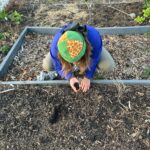
A C E C staff member is kneeling in front of a bare garden bed, holding soil in their palm.

I haven’t officially taken possession of my plot, but I’ve wandered over to take a look a few times. The soil doesn’t look as happy and healthy as the soil at the CEC demonstration site (although the CEC’s soil is about 32 years in the making), and it doesn’t smell as “earthy” or “mushroom-like” as Kayla recommends for a vegetable garden. It feels and looks a bit sandy, which has me thinking I should try to add some compost and/or organic matter.

A few months ago, someone dropped off a Bokashi at the CEC because they weren’t interested in using it anymore. The Bokashi system is a 5-gallon bucket that facilitates anaerobic fermentation of organic matter that produces a nutrient-rich liquid that you can use as plant fertilizer as well as a fermented residual that needs to be further composted. At the time, Zoe-Blue encouraged me to take the Bokashi home for some experiments. I hesitated for a few reasons. The first is that while I have many houseplants, I don’t have so many that I need a constant supply of liquid fertilizer. The second is that I wasn’t quite sure what to do with the residual besides put it in our apartment’s organics green bin. The third is that the Bokashi system uses a “bran,” or a mix of essential microbes on a cereal base. While you can buy bokashi bran online from Bokashi Living, I felt daunted by the shipping costs. So I had left the Bokashi sitting (lonely) on our balcony for the past few months.

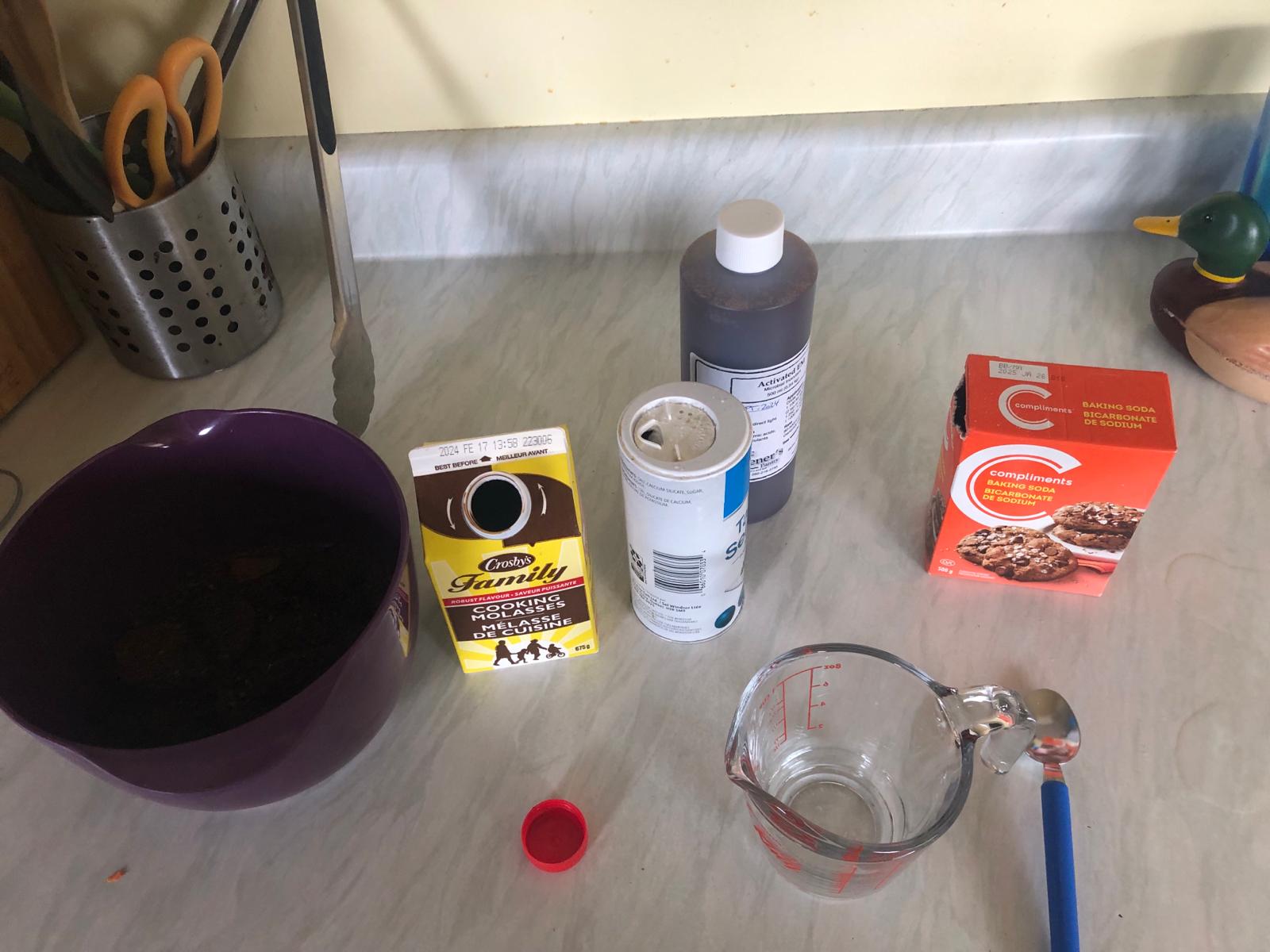
With the availability of a garden plot, I’ve felt re-energized to use the Bokashi. I stumbled upon this recipe for Bokashi bran using used coffee grounds. I had everything I needed on the recipe list to make the Bokashi bran except the “Effective Microorganisms,” (EM) and I was able to order those locally from the Organic Gardener’s Pantry. The Pantry’s owner, Christina, dropped the EM off for me at the CEC office this week. I’m excited to keep drinking coffee and get this Bokashi going. (I also realized when ordering the EM that Christina also sells Bokashi bran…so I’ve got a backup plan if this DIY approach doesn’t work out.)

In the meantime, my friend Amanda let me know where I could get some partially decomposed horse manure. Animal manure from cows, sheep, and horses can be an awesome soil amendment for home gardens. The manure supplies primary nutrients and micronutrients for plant growth, and it’s also a source of organic matter. By increasing the organic matter of the soil, you can increase the soil’s water-holding capacity, improve soil drainage, and promote the growth of beneficial soil microorganisms.

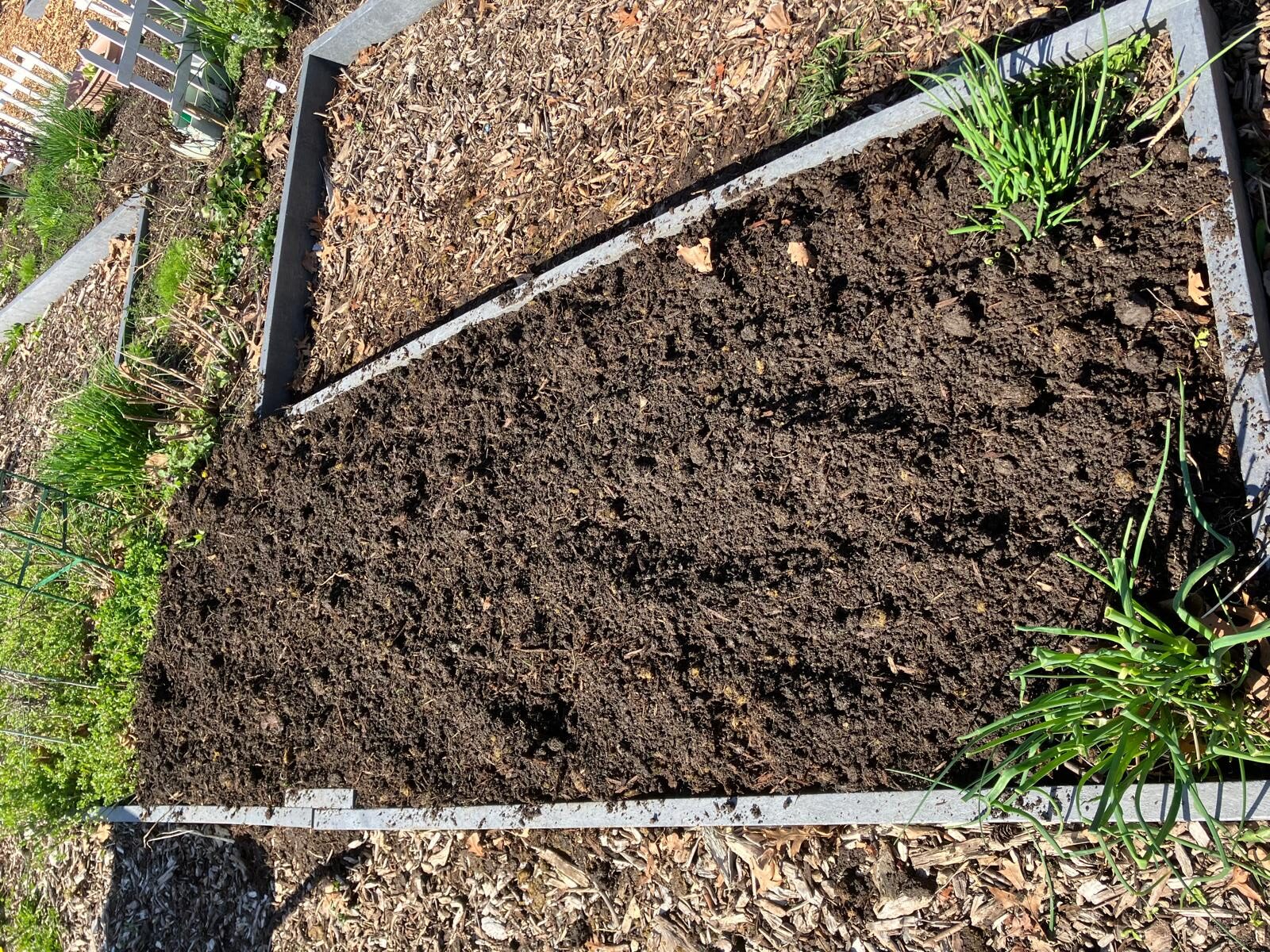
I have a few months until I plant and harvest so I applied about a wheelbarrow’s worth of manure, and I worked it in the soil. My plan is to keep any eye on it over the next few months, keep working it into the soil, and hope that it is more fully decomposed before planting.

After I mixed the manure in with the soil (which was so much fun!), I did get the warning from another friend that horse manure can contain a high amount of grass and weed seeds. This is something I’ll keep an eye on over the next few weeks, and I might do something differently next year!

Posted in Blog, Organic Gardening, ReflectionsTagged , , , ,

Updates from an Amateur Gardener, Pt. 1

April 10, 2024


I feel like I’ve won the lottery! A few weeks ago, I got an email from the Oswald Park Community Garden letting me know that there was a garden plot for me. How exciting! 

I live in a third-storey apartment with a very small balcony that doesn’t get a lot of light. I worked from home during the pandemic, and like many people, I got very into my houseplants. I did what I could with the balcony (and I confess I’ve killed a lot of plants). But after working for the Compost Education Centre amidst a beautiful demonstration site (come visit anytime!) for a couple months, I started to hanker for something more. The reasons to grow your own food are extensive. It increases your personal physical and mental health, leads to greater food security, and creates community. I think I also wanted to make the work I do a bit more tangible. As Executive Director, I do a lot of sitting at my computer and in meetings thinking and talking and writing about composting, circular food systems, and community resilience. I love it, but it can feel a bit abstract. I guess I want to make and use some compost with my hands instead of my words. 

I went down a bit of a rabbit hole trying to get my apartment building to okay me starting a boulevard garden, and I received a hard no from the building’s strata council. I put my name on some community garden waitlists, and I daydreamed about starting a guerilla garden somewhere on a piece of neglected land by our apartment. My partner and I talked about housing prices and whether we’d ever want to move out of our cozy apartment to somewhere with a yard. It didn’t feel like my energy was going anywhere. So when the message from Oswald Park Community Garden popped into my email inbox, it felt like a ray of sunshine on a grim late February day. It felt like the promise of spring warmth and long summer days. It felt like I had a place to put my energy. 

I’ve started polling folks for advice, and I have to admit my recent Google search looks something like “first year community garden plot help.” If I had known a few months ago that I was going to have a garden plot, I probably would have registered for Kayla’s “Grow the Best Garden: 5-Part Workshop Series.” Kayla is the CEC’s Site Manager and Community Education Coordinator, and one person who attended her workshops described her as their “invaluable gardening mentor guiding [them] through this journey with unwavering expertise and passion.” I’ve already missed the first two workshops of the series so I’m following the advice of one Redditor to “be patient, be prepare to fail, and be happy to start again.” I’m also asking Kayla for advice on our lunch breaks, and I’m poring over the CEC’s extensive factsheets. 

Stay tuned here for more updates! 

Posted in Adult Education, Blog, Fact Sheet, Featured, ReflectionsTagged , , , , , ,

Soaking Up Natural Dyes

January 4, 2024


In September, I attended a natural dyeing at the Yates Street Community Garden led by Angie Choly.  

I attended the workshop in hopes of learning some strategies for dyeing with natural material to bring to the high school gardens I teach in. The method we used was called bundle dyeing, and it was fun, effective, and quite simple!

The part of natural dyeing that always intimidates me is the mordanting process, which is essentially a way to pre-treat your fabric to make it more receptive to the dye and improve the stability of the colour in the finished product. Angie mordanted the fabrics for us using potassium aluminium sulfate, rinsed them and cured them in the fridge and brought them to us ready to go. I’ll have to get some practice mordanting on my own soon! 

After learning a little bit about other natural dyeing strategies, we got into our bundle dyeing process to create bandanas. We had all sorts of natural materials to choose from for our dyes. We used flowers including mallow, scabiosa, hollyhock, pansies, cosmos, zinnia, and more. We also used kitchen scraps including onion skins, turmeric, hibiscus coffee, cabbage, and berries.

I ended up using a lot of flowers, but I was really excited about the potential of dyeing using food scraps with high school students as it ties into our chats about compost and redefining what we consider waste so perfectly. And as a bonus? Food waste is a material that is so easy to access.

The bundle dyeing process itself is simple. It involves laying down all your materials on the bandana, and then rolling it up tightly in the way you’d roll a rug. If you fold it in half first, either rectangular or corner to corner you get a sort of mirror effect in the way the colour comes out (which is cool!). After that, you roll up your fabric into a spiral and tied tightly. The last step is steaming the piece the same way you’d steam a vegetable in the kitchen. We steamed our bandanas for about 30 minutes – you can see the results in the photos!

Interested in chatting with Elora about running a workshop with a group of students? Check out our offerings here.

This was such a fun way to engage with plants (that you can find in gardens, along boulevards, in sidewalk cracks, and other urban areas) as well as food scraps in a new way.

It can be difficult to find the time to pursue professional development and skill-building while also working as an educator with a busy teaching schedule. I was grateful to the Compost Ed Centre for making it possible, and I’m looking forward to integrating what I’ve learned into my teaching.

Thank you to the Yates Street Community Garden and Angie for hosting!

Support us by becoming a monthly donor today!

By Elora Adamson, Child & Youth Education Coordinator

Posted in Blog, News, Reflections, SustainabilityTagged , , , , ,

Mycology at the CEC

December 20, 2023


Ever since moving to the coast, I’ve been fascinated by flora and have spent a lot of time learning the names of the plants around me and how to recognize them. While spending so much time in the forest admiring plants, it became hard to ignore fungi when fall rolled around. Since 2021, I’ve been equally enamored with the fungal diversity that can be found here on the south island, which led me to join the South Vancouver Island Mycological Society (SVIMS). Joining the mycological society has been very fun, and has provided me the opportunity to learn from countless experts while expanding my knowledge of the fungal kingdom.


This fall, the CEC supported me in attending SVIMS’s annual Cowichan Lake Foray as a professional development opportunity. The Foray is a Friday-Sunday event consisting of several guided mushroom walks, identification and generally a survey of the fungal biodiversity in the area. There were a plethora of amazing things out there, but my mushr.oom find of the weekend was definitely finding my first Cauliflower mushroom (Sparassis radicata), which I was able to take home and cook with my roommates. Another fun part of the weekend was getting to help out in the identification room a bit. When I first joined SVIMS, I mostly practiced “keying out” mushrooms that others already knew what they were to get familiar with the process. Keying out is the process of identifying fungi using guidebooks and other resources. This time around, I tried my hand at keying out mushrooms that hadn’t yet been successfully IDed and ended up identifying one of them as a Tricholoma species that we only found one potential previous record of having been observed in British Columbia. SVIMS ended up sending it for DNA sequencing so it’ll be exciting to see if the results are a match for the ID I made!

Compared to plants and animals, there is a lot more we don’t know about what fungi species we have here in North America. Many species here are currently named for similar European species, but as more genetic sequencing is done, we are discovering that the species are distinct from their European counterparts and/or what we previously considered to be just one species is actually several. For this reason, even the most amateur mycologist can make interesting contributions by observing, documenting, and preserving specimens they find. While learning about the ever-evolving taxonomy of fungi is interesting, it’s even more intriguing to learn about all the various roles fungi have in the ecosystem as well as the ways they interact with plants, insects, animals. and everything in the forest.


In my role running the semester long Let it Rot (LIR) program at high schools in the CRD, it has been so great to get to incorporate mycology with the knowledge I’ve gained at SVIMS over the past two years. This fall, I ran a mycology unit as part of LIR which included a guided mushroom walk, a lesson in documenting fungi using field slips, recording key information, properly collecting and taking spore prints. We also learned about fungi’s many roles in the ecosystem and wrapped it up with some fungi trivia. The students were quite excited about mushrooms and got really into trying to spot them. Even this week in early December weeks after our mycology unit students were asking if we could do another mushroom walk. I’ll be looking forward to another mycology unit in 2024 when some spring fungi are out. And stay tuned for an adult introduction to mycology workshop fall 2024!

 By Elora Adamson, Child & Youth Education Manager

Keen to learn more with Elora about mushrooms?

Stay in the loop by becoming a member today

Posted in Blog, Child and Youth Education, Let It Rot, Professional Development, ReflectionsTagged , , , ,

Strategic Planning Updates

December 1, 2023


I joined the Compost Ed Centre as Executive Director in February 2023, and I’m constantly learning about who we are and what we do. Let me begin by saying that I am so grateful to work with Elora, Jeffrey, Kayla, and Zoe-Blue. Earlier this year in anticipation of our strategic planning, we sent out a survey to gather data from our community as to what they view as the Compost Ed Centre’s strengths and what they might want us to do differently in the next three to five years. Consistently, the responses highlighted knowledgeable, engaging, and passionate staff as our core strength. And for the future? For us to keep doing what we have been doing – and possibly some expansion!? The responses highlighted for me how well-established and well-loved the Compost Ed Centre is after 30 years of operation.


We want to share our many thanks to everyone who filled out a survey! We compiled the responses into a short PowerPoint to provide some context to our strategic planning.


What has resonated for me most in this role and what we have learned from you all is how the Compost Ed Centre creates impact through education and research. On one level, we transfer technical skills that empower workshop participants, site volunteers, university students, and schoolkids to take on climate mitigation and adaptation action. But on another – and more profound – level, we integrate folks into our community of plants and people. The Compost Ed Centre cultivates an increased sense of connectivity and reciprocity, and we do it by sharing knowledge in a welcoming way.

I can speak personally to how welcomed I have felt to this role and to the Compost Ed Centre’s community. I want to highlight how fortunate I’ve been to work with Alexis so much over the past few months as she has transitioned out of the Executive Director role. The pandemic and post-pandemic inflation has hit nonprofits hard, but Alexis’s steady and wise tenure as Executive Director made it possible for me to step into this role with a confident rather than crisis mindset. Amidst so much change in the world, I feel reassured that the Compost Ed Centre will continue to thrive in the same way for the next 30 years by catching and mixing folks right on into our community – just like the browns and greens in a hot compost pile.

Haven’t yet hopped into the hot compost pile?

Become a member of our community today!

We want to express our gratitude to the Government of Canada’s Community Service Recovery Fund, which has made our strategic planning work possible. The Community Services Recovery Fund is a one-time $400 million investment from the Government of Canada to support community service organizations, including charities, non-profits and Indigenous governing bodies, as they adapt and modernize their organizations. We have been able to engage in the staff retreat and other strategic planning activities with the support of the CSRF.

By Claire Remington, Executive Director


Posted in Announcement, Blog, Board, News, Reflections, Stategic PlanningTagged