Composable Cutlery Experiment

December 19, 2025


We here at the CEC are always down for an experiment! Recently, Kayla attempted to backyard compost take out cutlery from restaurants downtown. While these cutleries normally end up in green bins then industrial composting facilities (where they decompose more efficiently in oxygenated, high heat environments) we thought it would be interesting to see how much decomposition happens with these “compostable” items in a passive, backyard, cold compost system.

We tried composting a wooden fork and spoon, a hard paper fork with a coating from an unknown substance, and a hard “compostable” plastic fork. They were put in a tumbler composter with food scraps and yard waste from May to mid-November. The hard paper fork was the only piece to fully compost, but we still found remnants of its coating. The wooden cutlery was noticeably weaker, and the “compostable” plastic fork could have been washed and used to eat my lunch! Now, things might be different in an industrial composting facility, but compostable plastics are not an allowable feedstock (i.e. input material)  in BC…

Vancouver Island composting facilities, like one up in Cobble Hill – which receives most of the Capital regional districts green bin waste- is governed by the Ministry of Environment’s Organic Matter Recycling Regulations. In those regulations, compostable plastics are not an allowable feedstock (i.e. input material) and so Vancouver Island industrial composting facilities cannot accept compostable plastics. We’ve heard from regional industrial composting facilities that they’d prefer no compostable plastics be put into green bins because of this regulation, but also because their technology doesn’t quite allow for the full decomposition of the stuff – they end up sifting out partially decomposed / torn up compostable plastics that they then landfill.

There’s also an overlapping regulation here – the “Single Use and Plastic Waste Prevention Regulation” which provides a framework to phase out certain single-use and plastic items including compostable and biodegradable plastics. 

Lastly, plastic single use cutlery, including compostable plastic cutlery is banned under Federal regulations! Ack!

Mostly here at the CEC we really want to amplify the benefits of backyard composting – materials, nutrients and finished compost then stays in the region, and we create more closed look circularity in our food system. And sometimes the variety of products for take out and food storage can be very confusing! The very BEST option ever, is to skip any sort of single use thing – instead choose a reuseable! Bring your spork with you wherever you go, pack your to-go mug in your bag, and choose to dine in at restaurants or pick up your takeout from restaurants using programs like the bread-and-butter collective’s or Nulla’s reusable takeout container programs. If you’re keen to learn more about these topics you can sign up to participate in our Zero Waste Living workshop happening on February 21. And check out the CEC’s Understanding Compostable Plastics Factsheet, Zero Waste Living Factsheet, and the City of Victoria’s Sustainable Takeout Guide.

Posted in Blog, Composting, Fact Sheet

New Composting Resources for Businesses

December 17, 2025


Here at the Compost Education Centre our education has mostly revolved around supporting residents of the Capital Regional District compost at home. And we have more expertise than that! Over the years we’ve offered informal business consultation, answering many questions from the public about composting at a workplace or at their business. We decided in 2025 to formalize some of this education by offering free “Composting and Food Waste Reduction for Businesses in the CRD” webinars and writing and publishing a free “Composting for Businesses” factsheet to add to our awesome list of other factsheets. Businesses in the Capital Regional District don’t have waste management services provided to them like some municipalities provide for single family dwellings (e.g. curbside garbage and organics collection) so a business is responsible for managing their own waste. Different businesses tackle this in different ways, and there are a few different options with different benefits and drawbacks. To try and provide an overview of possibilities and to provide some context for why waste management for businesses matters, we wrote this Factsheet. Check it out! And we’ve also scheduled a couple more “Composting and Food Waste Reduction for Businesses in the CRD” FREE webinars, so join us on Feb 4 or May 14. See you there.

Posted in Announcement, Blog, Composting, Fact Sheet, Waste Diversion

Composting Connections from Haida Gwaii

October 22, 2025


By Kayla

I recently had the valuable opportunity to see a medium scale community composting facility in operation in Old Masset on Haida Gwaii during a personal holiday. The community there has about 80 households filling 5-gallon buckets with food scraps from their kitchen, and then employees of the project pick up the bucket contents and bring them back to their EarthFlow composter – “an automated compost mixing and aeration system” inside a shipping container. Food waste is added to the shipping container, an auger breaks up and mixes the materials, automated irrigation can be toggled on and off depending on the moisture level of the feedstock, gases and emissions are captured in a biofilter before being released outside. While the community in Old Masset is still honing their process of storage, curing and use for the finished compost, they are excited that they are diverting a lot of waste from their landfill! Through this program they are building community, creating climate resilience as they process their own waste, creating a valuable soil amendment to nourish their sandy soils, and they are creating valuable employment opportunities for community members. I loved seeing this project in action and seeing Dave’s market garden where some of the finished compost is completing its curation phase.

Thank you so much to Calvin and Trudy and Filene from the Indigenous Zero Waste Technical Advisory Group for connecting me to Dave and for supporting such a great community scale composting operation in Old Masset. I’m very happy to hear that IZWTAG is also supporting many other composting systems of this scale across the province in different communities. Thank you to Dave for showing me around his market garden and garden scale composting operation and showing me the EarthFlow composter in action in Old Masset.

I feel so inspired to be connected to a wider community of people who care about stewarding the soil, reducing methane emissions from landfill, and building community resilience. Us compost keeners are everywhere 😉

Posted in Blog, Composting, Food Security, Reflections, Sustainability, Waste Diversion

Closing the Loop at Saanich Neighborhood Place

August 1, 2025


Compost Education Centre board member Tina wears a lot of different hats at Saanich Neighbourhood Place, a neighbourhood house that provides child care, family, seniors, and community programs. Like other neighbourhood houses in Victoria, SNP has taken on a lot of food security initiatives to respond to community need. SNP provides free food to the community through their Best Babies, Family Dinner, Community Kitchen, and Community Fridge programming. Tina is the Head of Food Security and a chef at SNP: she teaches workshops, makes delicious and healthy meals for the community, and she manages all of the organization’s food rescue.

About 70% of the food distributed through SNP programming is food that is “rescued” or donated. SNP purchases the remaining 30% of food required. Tina and other SNP staff have developed connections with local farmers like Gatton House Farm and Gorge Tillicum Urban Farmers that donate fresh produce. Neighbors and community members also donate any excess produce they might have, and SNP also receives rescued food from the Mustard Seed and Save On Foods.

The secret to making it all work? Volunteers, community connections, and Tina’s creativity. SNP relies on volunteers to pick up and transport food, and all the donations made by local growers are based on informal – and community-driven – relationships and community connections. And once Tina receives all the donated and rescued food, she crafts accessible menus and meals. She’s a wizard! She manages to figure out what to cook based on what’s available week-to-week.

You would think that Tina had enough on her plate (literally and figuratively!) without taking on more, but she has a vision for SNP and all community organizations in the region: composting and food-growing. Currently, SNP sends some of their organic waste to a local farm, some home with staff to compost at home, and the remainder into a green bin service that they pay for. SNP produces about one full green rollaway bin of organic waste a week, and they’d love to be composting that waste on-site instead to be able to support food growing.

Tina composts at home, and she notices a big difference in her garden. She has a simple composting system, and she notices a huge impact on her garden by amending her soil with the compost twice a year. She wants everyone to be composting more because of how it’s so much better for our environment. Instead of using fertilizers that run off into our waterways, we could instead be “closing the loop” and producing compost that supports our gardening initiatives. It just makes sense to keep all that valuable organic material on-site.

SNP has some underused green spaces that could accommodate a composting system and some growing gardens. Tina and her SNP colleagues see a real opportunity to integrate composting and food growing education into all of their programming – and so do we! We’re looking for funding to support them in establishing those composting systems and accessing whatever education needed.

Posted in Blog, Board, Composting, Featured, Food Security

Composting is Key to Sustainable Urban Agriculture

February 16, 2024


My partner recently sent me this article, Urban agriculture’s carbon footprint can be worse than that of large farms, and I felt a sense of outrage and surprise. I love urban agriculture!

I was relieved to dig a little deeper into the publication to find that the study did find that urban agriculture has a smaller carbon footprint than conventional agriculture when the following practices are followed:

Composting

Rainwater harvesting

Using construction debris and demolition waste for infrastructure

– Longer-term use of infrastructure and tenancy of a space

The Compost Education Centre helps to steward several urban gardens including at our demonstration site, a boulevard garden network in the Fairfield-Gonzales neighborhood, the Alexander Park Orchard, and SJ Burnside Secondary School’s teaching garden. Our demonstration site features eight different composting systems, rainwater cisterns and barrels, and a solar-powered aquaponics system. Come by anytime for a visit!

We have found that urban gardens serve as powerful outdoor classrooms that inspire local climate mitigation and adaptation activities. For example, our urban gardens empower community members to:

– Produce food locally with the objective of improving food security and mitigate emissions associated with our food system.

– Cultivate native plant and pollinator gardens to support pollinators, which are under threat from climate change.

– Implement rainwater harvesting to reduce climate change vulnerability.

In addition to acquiring technical skills, our community members experience increased connectivity to a peaceful and welcoming space in Victoria. We consider our urban gardens to be a nature-based driver for social cohesion and improved climate change adaptation – and we’re excited that the research backs us up, too.

Claire Remington, Executive Director

Posted in Blog, Composting, Organic GardeningTagged , , , , , , , ,

The Secret life of worm herders

March 4, 2023


Our resident worm herder and child and youth education coordinator, Jeffrey was featured in a Saanich News article on worm composting.  In the article and accompanying video, Jeffrey demonstrates how worm composting can help us keep food waste out of the landfill and composting facilities, while creating a nutrient dense growing medium for gardeners. Click here to read the article ??

Posted in Blog, Composting, NewsTagged , , ,

Worm Poop Centennial Project

August 25, 2021


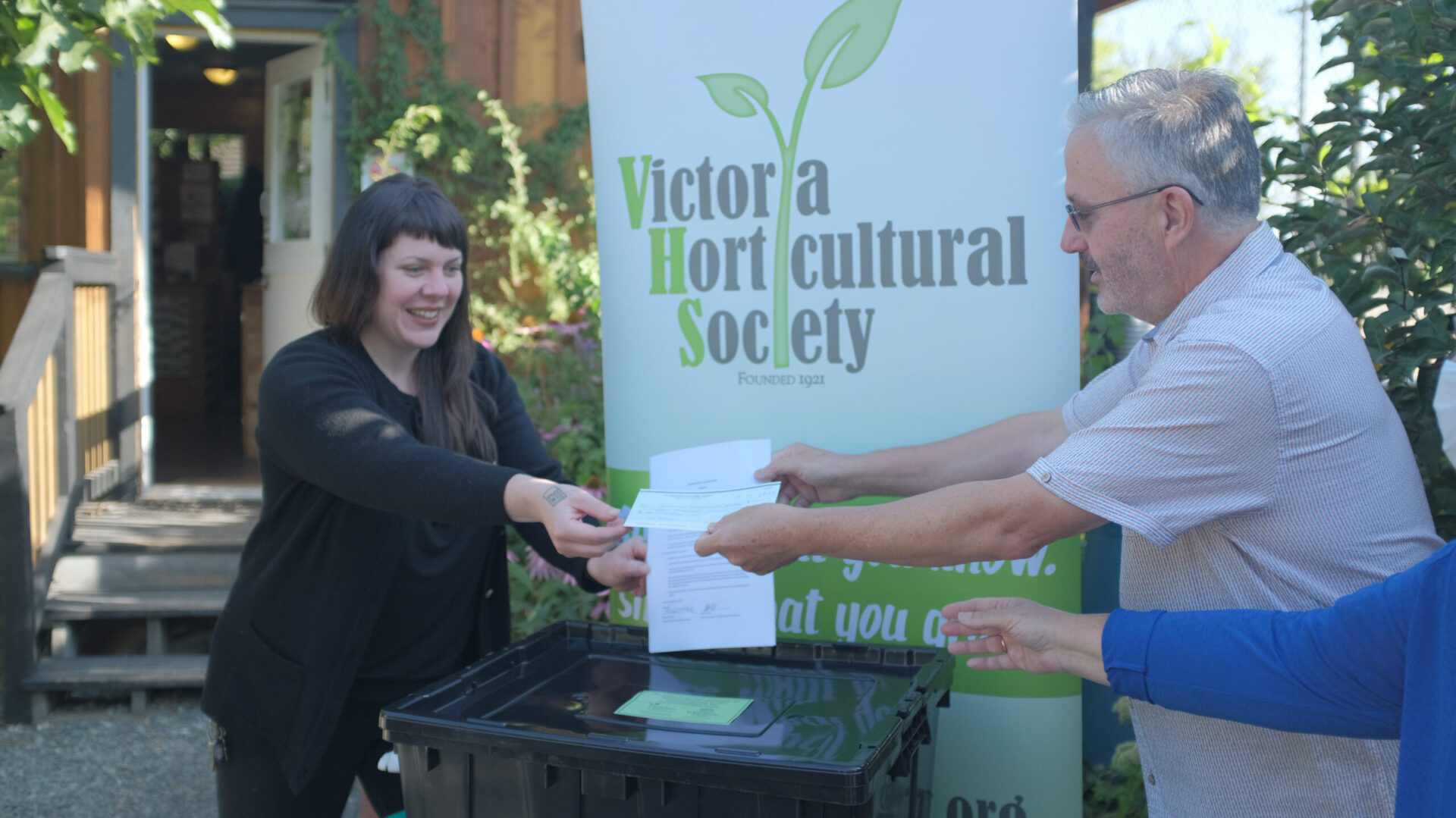
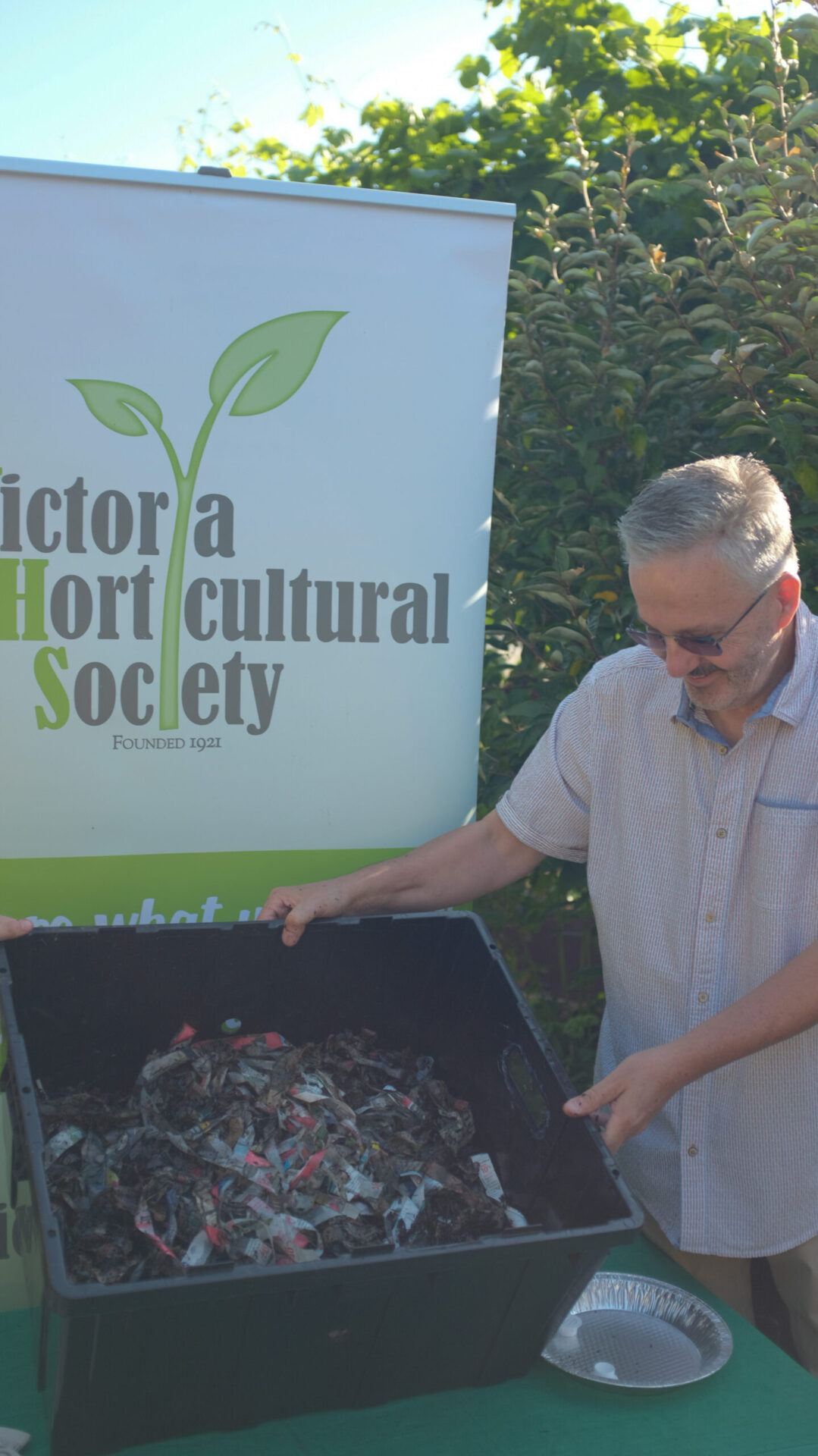
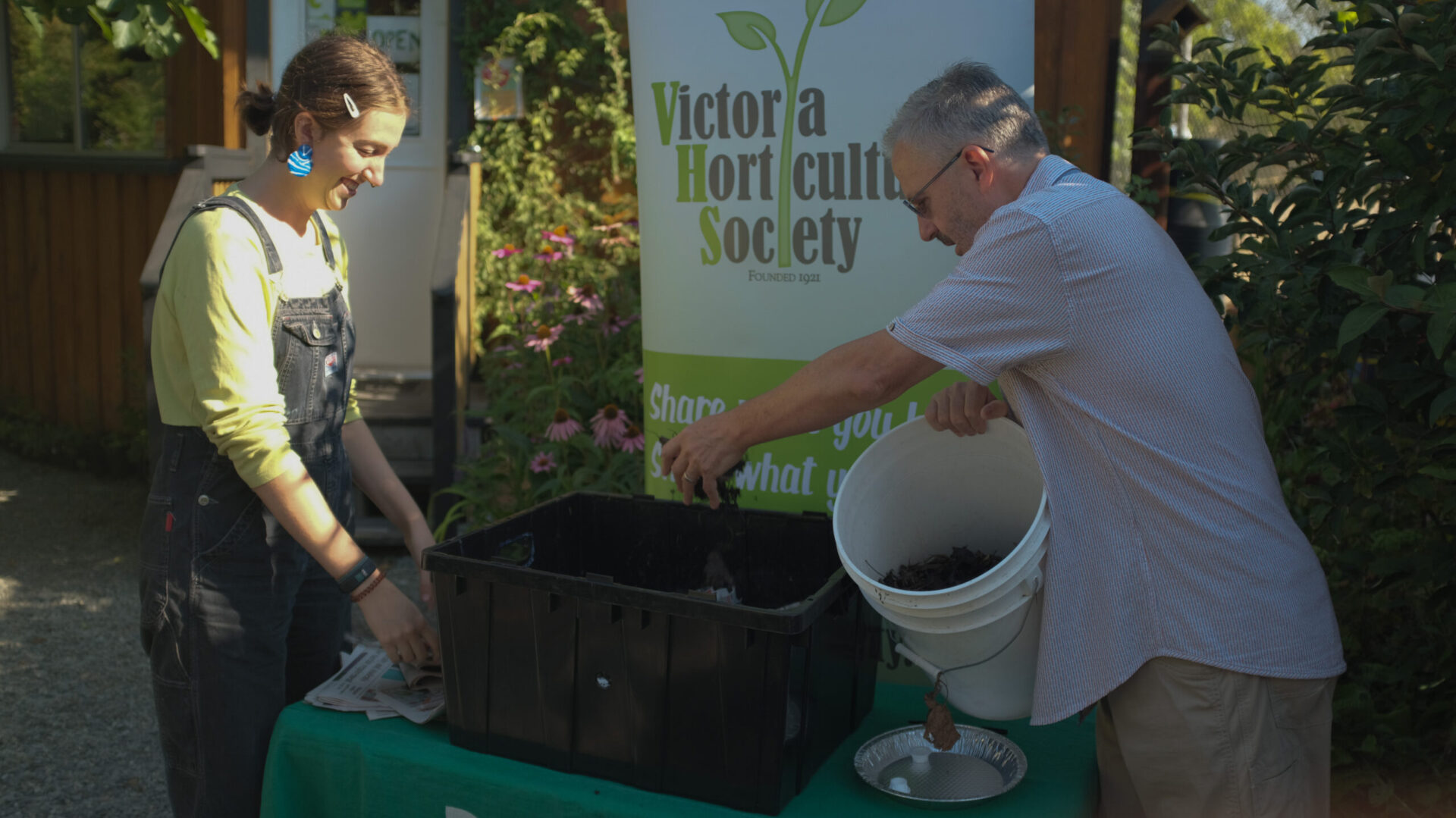
It is with much gratitude that we launch the Worm Poop Centennial Project! This project is in partnership with the Victoria Horticultural Society who is celebrating 100 years of hands-on gardening education. Through the VHS’ generous donation we are able to give away 100 worm bins to interested non-profit and educational groups when they book a worm composting workshop with us. Get in touch with Elora, to learn more about this initiative at education@compost.bc.ca

Posted in Announcement, Blog, Composting, Organic Gardening, PartnershipsTagged , , , , , , , Leave a Comment on Worm Poop Centennial Project

Troubleshooting Roots in Your Compost Bin

August 10, 2018


Though composting can be a pretty basic process once you understand the fundamentals, there’s bound to be a few hiccups along the way. In this video, Site Manager and Adult Education Coordinator, Alysha Punnett, shows us how to tackle the invasion of wandering roots in a compost bin.

Posted in Blog, Composting, Featured, News, Organic Gardening, ReflectionsTagged , , , , ,

How to Apply Vermicompost (Worm Castings) To Your Veggie Bed

August 2, 2018


Posted in Blog, Composting, Featured, News, Organic GardeningTagged , , , ,

Cold Weather Composting

October 5, 2017


Cold weather composting

Above is a link to the article written by Alysha Punnett, the CEC’s site manager, published by the Fernwood NRG.

Posted in Blog, Composting, News, Organic GardeningTagged , , , , ,