Turning in the Cover Crop

April 21, 2017


It’sspringit’sspringit’sspring!  FINALLY.

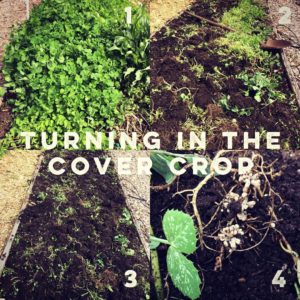
The cover crop of crimson clover and winter field pea that I sowed the veggie beds with last fall has also been enjoying the warmer weather in a big way.  Before I knew it, it had put on 6 inches of new growth and it was time to shear, compost and turn in in preparation for planting season.

Generally, you want to get this done a few weeks before planting anything in the bed.  This allows the roots of the cover crop to die, releasing their fixed nitrogen back into the soil, which can then be taken up by your transplants.  A side benefit is that it turns pest cocoons and larvae up to the surface where they can be gobbled up by birds, other insects or killed off by the weather.

First, I shear the tops off the plants and toss them in my compost pile.  There’s a lot of green material there, so I tend to make a big hot compost.

My shovel strategy:

Many use tillers to turn in cover crops, and this is necessary if you’ve used a more robust crop such as winter rye.  Because I choose more tender crops, I use a shovel and chop two rows down the bed, then chop perpendicular to the rows to create a kind of grid over the bed.  This allows you to lift chunks of the cover crop and flip them completely over.  Once this is complete, I gently chop my way through the whole bed to cut the roots up and ensure the cover crop dies off in time for planting.

As you go, keep an eye out for the tell-tale root nodules that show you how hard your nitrogen-fixing cover crop (i.e. legumes such as crimson clover or winter field pea) has been working for you.  As the plants die, this nitrogen is returned to the soil.

Want to know more about the benefits of cover cropping?  Head over to our FacebookInstagram, or Twitter and leave us a comment that says “Tell me more!”.

Save

Save

Save

Save

Posted in Blog, Composting, Featured, Organic GardeningTagged , , ,

May 13th, Spring Organic Plant Sale, 10am-2pm

April 13, 2017


Spring Plant Sale Poster 2017

The Compost Education Centre (CEC) is hosting our 15th annual all-organic spring plant sale! The event is on Saturday May 13th, 10am-2pm at the CEC demonstration site at 1216 North Park Street. The Spring Organic Plant Sale features local farmers offering a wide variety of organically grown vegetable, flower and herb seedlings to get you off to a successful start this growing season.

What you can look forward to:
• The largest selection of organically grown heirloom tomato varieties all in one place for easy shopping
• Organically grown vegetable starts from arugula to zucchini
• Native plants for your low maintenance garden
• Perennial edibles like berry bushes and other fruiting shrubs
• Medicinal herbs like English lavender, chamomile and yarrow
• Culinary herbs like Genovese basil, dill and chives
• Companion plants like marigolds, sweet cicely and comfrey
• Live music!

Vendors this year will include Saanich Organics, New Mountain Farm, Mason Street Farm, Metchosin Farm, Fiddlehead Farm, TreeEater Nursery and Ravensong Seeds/Miss Mullein’s Herbals.

The Compost Education Centre is located on unceded and occupied Indigenous territories, specifically the land of the Lekwungen speaking people—the Esquimalt and Songhees Nations. These nations are two of many, made up of individuals who have lived within the porous boundaries of what is considered Coast Salish, Nuu-Chah-Nulth and Kwakwa’wakw Territory (Vancouver Island) since time immemorial. At the CEC we seek to respect, honour and continually grow our own understandings of Indigenous rights and history, and to fulfill our responsibilities as settlers, who live and work directly with the land and its complex, vital ecologies and our diverse, evolving communities.

Posted in Announcement, Blog, Events, News, Organic GardeningTagged , , , ,

Fall Organic Plant Sale on Saturday August 27th!

August 3, 2016


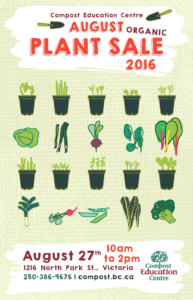
AugustPlantSale Poster 2016

Our annual August Organic Plant Sale is coming up on Saturday Aug 27th, 10am-2pm at the Compost Education Centre, 1216 North Park St!

The sale is a great chance to get local, organic veggie starts for winter growing! Come on out to the little sister of our spring organic plant sale and get your greens for the winter. Kale, broccoli, cabbage, salad greens, culinary herbs, medicinal herbs and much, much more will be available.

Farmers:

Save

Posted in Announcement, Blog, Events, News, Organic GardeningTagged , , , , , , ,

Spring Organic Plant Sale Saturday May 7th

April 14, 2016


Saturday, May 7th from 10am-2pm!  Amazing, all-organic, all-local veggie, herb and flower starts for your garden sold right outside the Compost Education Centre at 1216 North Park St.!

Continue reading “Spring Organic Plant Sale Saturday May 7th” Posted in Announcement, Blog, Events, News, Organic GardeningTagged , , , , ,

Brand new factsheets!

March 16, 2016


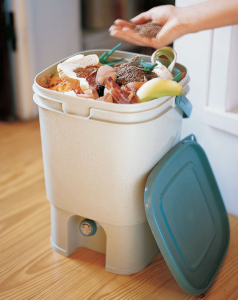
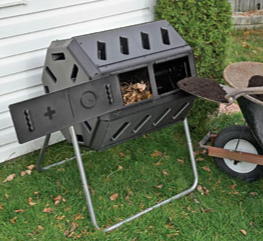
We are excited to share two new factsheets with you!  We have been getting lots of inquiries about tumbler composters and bokashi and we decided to put together a factsheet for each one to help answer your questions and spark your interest.  If the descriptions below spark your interest, check out the new additions on our factsheets page.

bokashi

Bokashi is a Japanese term meaning “fermented organic matter”. Different from composting, which is aerobic, it is an anaerobic process that allows a person to deal with a wide variety of food waste on-site. Bokashi harnesses the power of effective microorganisms (EM) dehydrated onto a cereal base to carry out the fermentation process . It is best used as a partner to a compost pile, because you will need a place to compost the ‘spent’ material once it has finished going through the bokashi process. It is a great alternative to the green cone food digester as it breaks down the same types of materials but doesn’t need sunlight or to be buried down 2 feet in your garden work. You can make your own system or purchase a ready-to-use unit.


tumbler

In general, tumbler composters are in the form of a barrel mounted on a stand so the unit can be turned or “tumbled” around a central axis.  They can be mounted horizontally or vertically, both work  well.  Turning these units easily incorporates air into the material inside the tumbler, which can speed up the decomposition process.  It is possible that you may get a finished product faster than with passive backyard composting due to the increased aeration that tumblers make possible.  However, beware of manufacturers that say you will have finished compost in three weeks or less – anything that looks finished in this short amount of time will be unstable and need to sit for at least 6-8 weeks longer to cure.


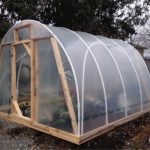
greenhouse

When we built our new greenhouse wanted the plans for this project to be free and readily accessible.  As such, this factsheet includes a budget and materials list for the greenhouse, a list of the lessons I learned, and some photos of the building process.


Posted in Blog, Composting, Fact Sheet, Featured, Organic Gardening, Waste DiversionTagged , , , , ,

Presenting our new video!

July 22, 2015


Drum roll, please! Presenting our OFFICIAL VIDEO!

Huge thanks to Aldridge Street Print & Media for doing such an awesome job!

Posted in Announcement, Blog, Composting, Featured, News, Organic Gardening, Reflections, StaffTagged , , ,

FOR THE LOVE OF SOIL EDUCATION DAY JUNE 6TH

May 13, 2015


Special lecture and workshops to celebrate compost, the “heartbeat” of our soil!

Continue reading “FOR THE LOVE OF SOIL EDUCATION DAY JUNE 6TH” Posted in Adult Education, Announcement, Blog, Events, News, Organic GardeningTagged , , , , , ,